Physical Description
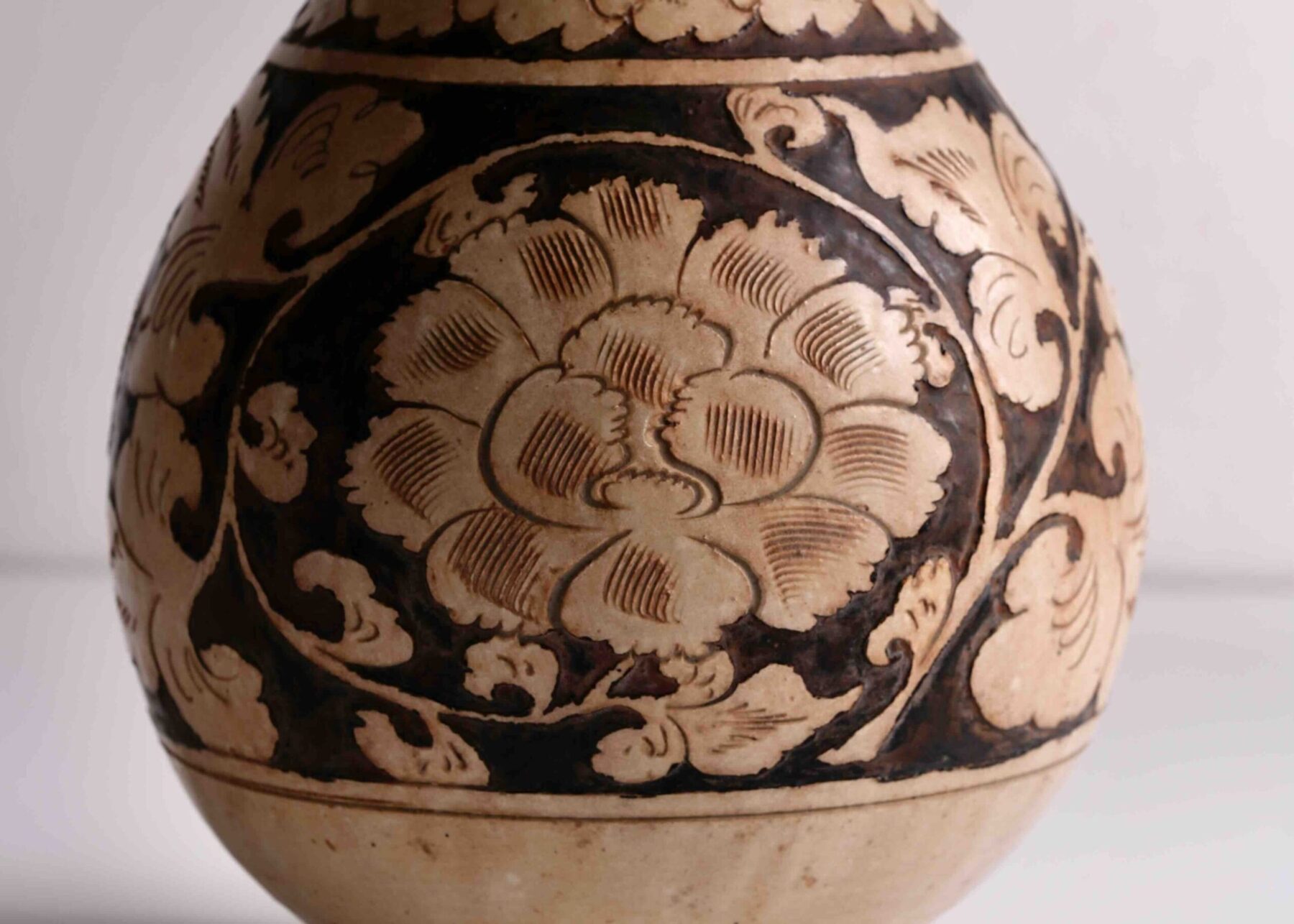
The vase is of pear-shaped bottle form, with a rounded body rising to a slender neck and gently flared rim. The principal decorative field is centered on a large peony blossom within scrolling foliage, executed in sgraffiato technique. The design is carved through a pale slip to reveal the darker body beneath, producing a strong tonal contrast. The shoulder is encircled by a band of upright petal or flame motifs, while the lower body is defined by a plain border above the foot. The composition is bold and fluid, characteristic of northern Cizhou wares.
Glaze, Body & Foot
- Glaze: A transparent, slightly creamy glaze applied over white slip, with a soft, even sheen and minor surface variation.
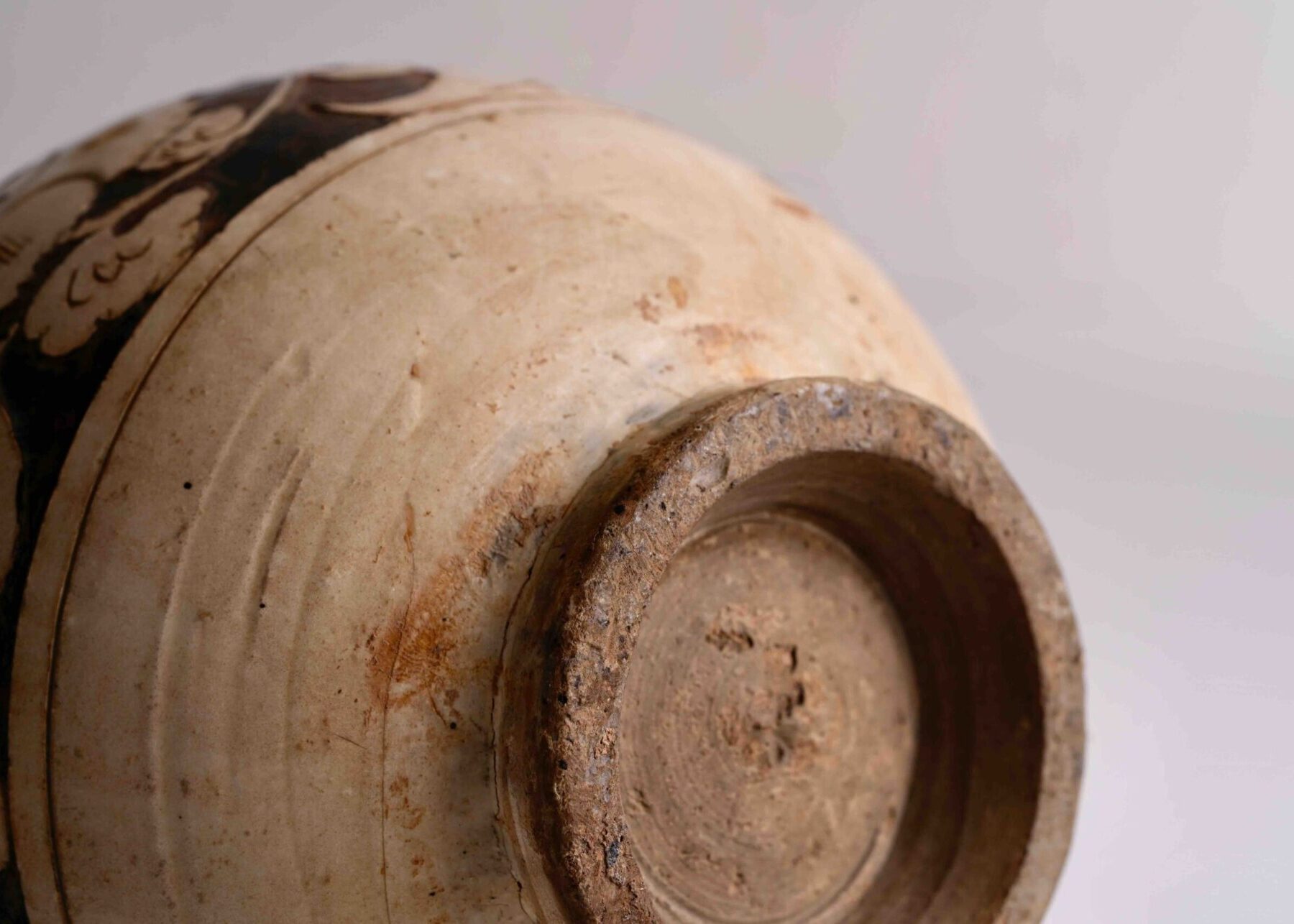
- Body: Dense stoneware of buff to light brown tone, visible where exposed.
- Foot: Unglazed foot ring revealing the coarse body; the recessed base shows trimming marks and firing residue, including kiln grit.
Form & Function
Vessels of this type were produced for domestic display and practical use. The bottle form is suitable for flowers or branches, though equally appreciated as an object of ornament. Cizhou wares reflect a more expressive aesthetic than contemporary court ceramics, with emphasis on bold decoration and lively surface design.
Comparisons
Comparable sgraffiato-decorated wares with peony scrolls are preserved in the Palace Museum, Beijing, the British Museum, and the Metropolitan Museum of Art. The present example aligns closely with northern Cizhou productions of the Song–Jin period in both technique and decorative vocabulary, though its elongated neck distinguishes it from more standardized meiping forms.
Features Supporting Attribution
- White slip ground incised in sgraffiato technique
- Bold peony and foliate scroll decoration
- Transparent glaze over slip
- Buff stoneware body typical of northern kilns
- Unglazed, roughly finished foot with kiln residue
- Form consistent with Cizhou-type bottle vases
Attribution Note
The combination of slip decoration, sgraffiato technique, and robust floral design supports attribution to the Cizhou ceramic tradition of North China. The strength and scale of the carved ornament, together with the tonal contrast, suggest a date extending into the Jin dynasty rather than the earlier Northern Song alone. While precise kiln-site identification remains uncertain, the piece is consistent with production in the Cizhou kilns or related workshops in Hebei or Henan.
Proposed Attribution
Late Northern Song–Jin dynasty (12th–13th century)
Cizhou kilns, North China
References
Chinese
- 《中国陶瓷史》, 中国硅酸盐学会编. 北京: 文物出版社.
- 《磁州窑》, 冯先铭等编. 北京: 文物出版社.
- 《中国出土瓷器全集》, various volumes relating to Song and Jin northern kilns. 北京: 科学出版社.
- 《宋代瓷器》, 故宫博物院编. 北京: 紫禁城出版社.
Western
- Medley, Margaret. The Chinese Potter: A Practical History of Chinese Ceramics. Oxford: Phaidon.
- Watson, Oliver. Ceramics from Islamic Lands.
- Valenstein, Suzanne G. A Handbook of Chinese Ceramics. New York: The Metropolitan Museum of Art.
- Kerr, Rose. Song Dynasty Ceramics. London: V&A Publications.
- Rawson, Jessica, ed. Chinese Ceramics in the Meiyintang Collection.