Physical Description
This vessel is of classical
meiping (plum vase) form, characterized by a small mouth, short neck, full rounded shoulders, elongated swelling body, and narrow foot. The silhouette presents a gently tapering, olive-shaped profile typical of Song dynasty wine vessels.
The body is fully covered in a luminous
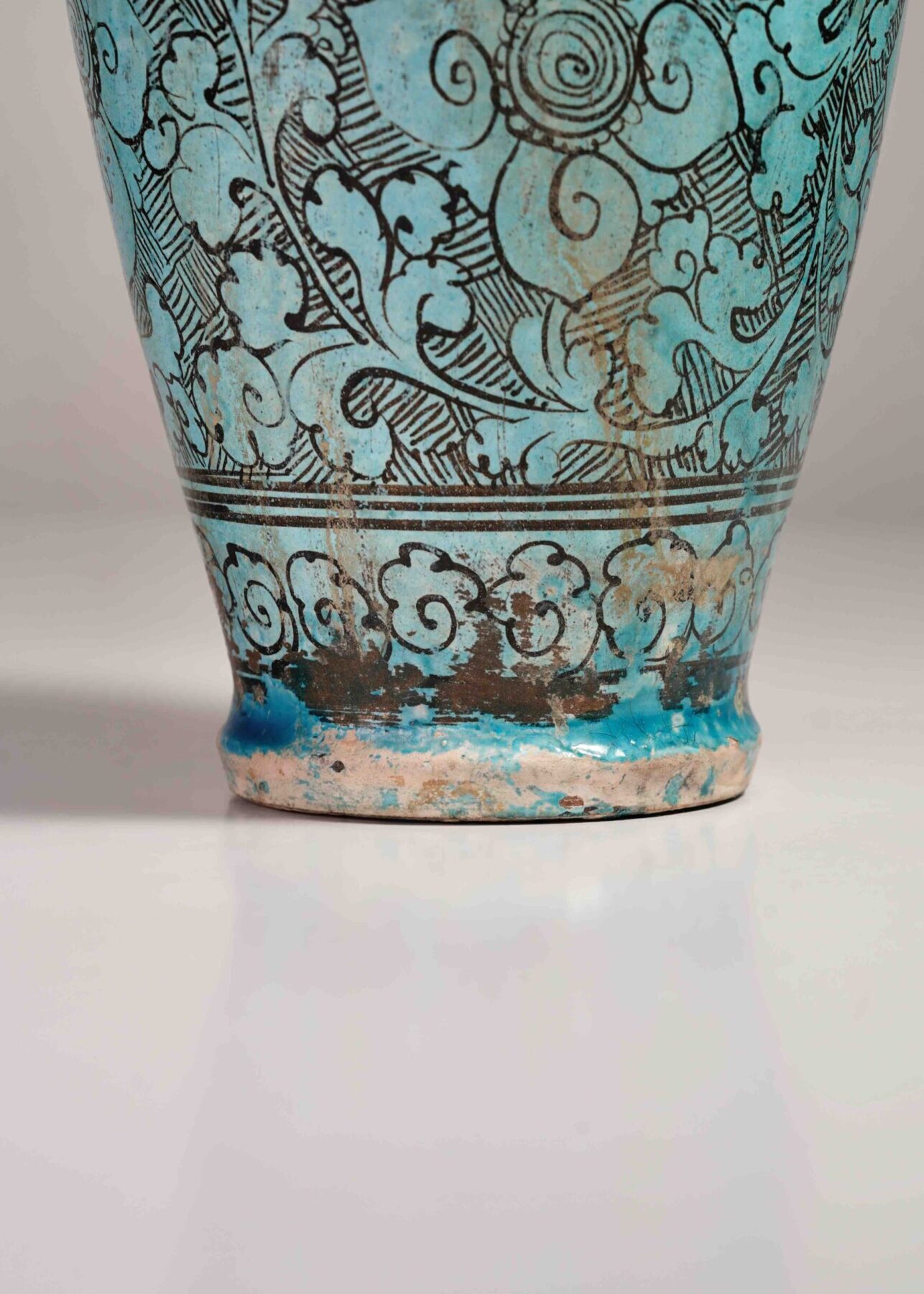
peacock-blue glaze, serving as the ground for intricate black-outlined scrolling floral decoration. The principal motif consists of continuous
lotus scrolls (缠枝莲纹) interwoven across the surface, arranged in a symmetrical and rhythmically balanced composition. Horizontal bands encircle the upper body, including a key-fret (雷纹) border that frames the ornamental field.
The decorative scheme is dense yet orderly, reflecting the Song aesthetic balance between structural clarity and ornamental refinement.
Glaze, Body & Foot
- Glaze:
The peacock-blue glaze displays a blue-green tonality reminiscent of peacock feathers. The surface is glossy with subtle tonal variation and visible crackle (开片), which enhances depth and texture. Under changing light, the glaze shifts between cooler blue and warmer turquoise hues, demonstrating layered chromatic complexity.
- Body:
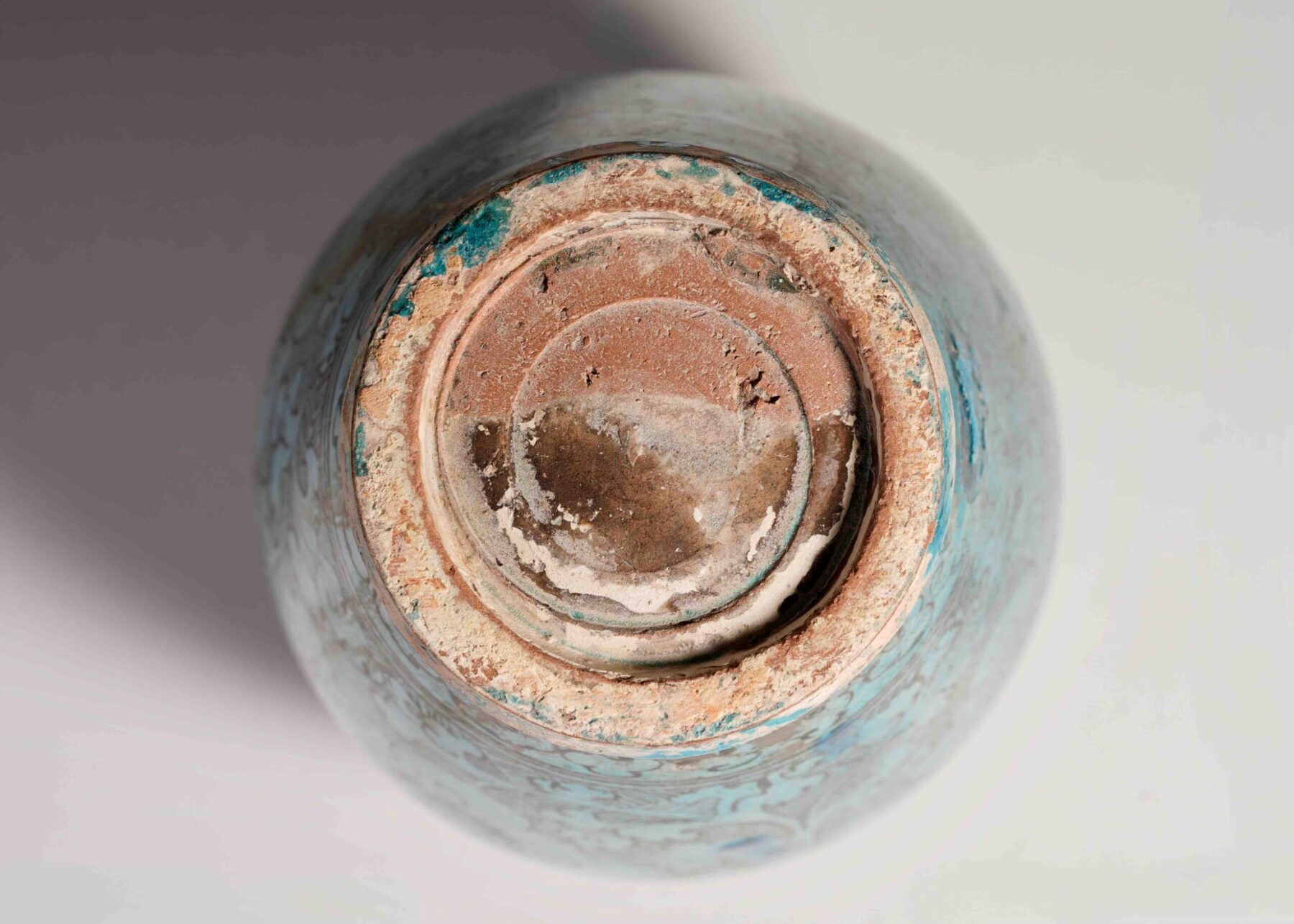
The exposed base reveals a buff to reddish stoneware body, compact and well-fired. The paste is dense, with a mineral texture typical of high-fired wares rather than true porcelain.
- Foot:
The vessel stands on a small foot ring, largely unglazed, showing firing traces and natural kiln adhesion. The glaze terminates just above the foot, with slight pooling at the junction.
Form & Function
The
meiping emerged during the Tang dynasty and became particularly prominent in the Song period as a wine storage vessel. Its narrow mouth minimized evaporation, while the ample shoulders and elongated body allowed for efficient storage.
In Song material culture, such vessels also held aesthetic significance beyond utilitarian function. The refined proportions reflect the literati preference for restrained elegance, while auspicious lotus scrolls symbolize purity, renewal, and continuity.
This example demonstrates the Song dynasty’s mastery in integrating foreign-derived glaze technologies with indigenous decorative vocabulary.
Glaze Technology & Cultural Context
Peacock-blue glaze, with its vibrant blue-green hue, is associated with copper-based glaze chemistry. The technology is believed to have been introduced from Western Asia during the Five Dynasties period through maritime trade routes and subsequently absorbed into Chinese ceramic production.
During the Song dynasty — a peak era of ceramic innovation — such glazes were further refined and harmonized with Chinese decorative aesthetics, resulting in distinctive hybrid forms that embody cross-cultural exchange.
Comparisons
Comparable Song dynasty meiping forms are preserved in:
- The Palace Museum, Beijing – Northern Song wine vessels
- The British Museum – Song dynasty storage vases
- The Metropolitan Museum of Art – Song stoneware vessels with monochrome glazes
While most surviving Song examples emphasize monochrome celadon or white wares, rarer colored glaze traditions demonstrate experimentation and regional kiln diversity.
Features Supporting Song Attribution
- Classical meiping proportions consistent with 11th–12th century examples
- Integration of peacock-blue glaze with Chinese lotus scroll decoration
- Restrained yet harmonious overall composition
- High firing and compact stoneware body
- Symmetrical decorative arrangement characteristic of Song ornament
Attribution Note
The formal structure, glaze tonality, and decorative vocabulary align with Song dynasty ceramic aesthetics. The peacock-blue glaze reflects technological exchanges active during the Five Dynasties and Song periods, while the meiping form is firmly rooted in Song vessel typology.
It should be noted that peacock-blue glazed wares were occasionally revived in later dynasties, particularly during periods of archaistic interest. However, based on stylistic coherence and formal analysis, the present work is catalogued as a
Song dynasty ceramic, pending further scientific examination.
Proposed Attribution
Song Dynasty (960–1279 CE)
China, kiln site unconfirmed
Peacock-blue glazed meiping with black lotus scroll decoration
References
- Kerr, Rose. Song Dynasty Ceramics.
- Medley, Margaret. The Chinese Potter: A Practical History of Chinese Ceramics.
- Valenstein, Suzanne. A Handbook of Chinese Ceramics.
- Palace Museum, Beijing – Catalogue of Song Dynasty Ceramics.
- British Museum Collection Online – Song Dynasty Wine Vessels.